MEAL Health Check
CLIENT / PARTNER
Center for Human Rights Defender Association (CHRDA)
COUNTRY / REGION
Libya
Project Period
Oct 2023 – Apr 2024
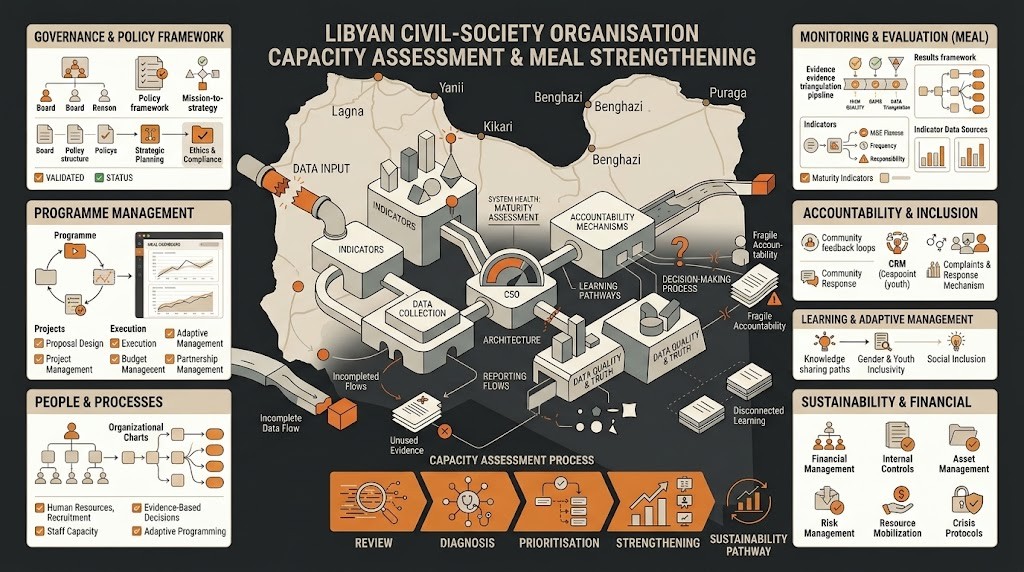
CHRDA operates in a demanding human-rights environment, supporting Libyan human rights defenders and civil society while undertaking advocacy, research, protection and capacity-strengthening activities. Organisations working across this range of functions need internal systems that can support programme quality, accountability, institutional learning and consistent evidence use without creating processes that are disproportionate to their size or operating reality.
The assessment therefore needed to go beyond a conventional compliance review. Its purpose was to build a structured understanding of organisational strengths and capacity gaps, identify areas where systems could be strengthened, and translate the diagnosis into priorities that were realistic for the organisation to implement.
The organisational capacity assessment was independently led using the USAID Organizational Capacity Assessment framework. The process examined organisational systems and management practices across relevant capacity areas, with particular attention to programme management, project performance, monitoring and evaluation, organisational learning and the systems required to generate and use reliable evidence.
Rather than treating capacity assessment as a scoring exercise alone, the findings were interpreted to identify practical priorities for organisational development. The engagement also supported the structuring of CHRDA's MEAL function, helping connect monitoring, reporting, evaluation and learning more clearly with programme management.
The wider assignment included leadership of a final project evaluation, allowing institutional-strengthening recommendations to be informed by both organisational systems and evidence from programme implementation.
The assessment provided CHRDA with a structured diagnosis of organisational capacity, highlighting existing strengths alongside priority areas requiring further development. The process translated assessment findings into practical recommendations intended to strengthen programme quality, sustainability and institutional learning.
The engagement also contributed to establishing a more structured basis for the organisation's MEAL function and demonstrated how capacity assessment can be used as a management and learning tool rather than simply as a donor-compliance exercise.
For Mizan Evidence, this experience directly informs the philosophy behind the MEAL Health Check: diagnose the system, identify what matters most, and convert the diagnosis into a realistic path for strengthening organisational practice.