Insight
How AI Can Strengthen MEAL Without Replacing Human Judgment
A practical guide to using AI across MEAL workflows while protecting evidence quality, confidentiality, context, human judgment and accountability.
Mizan Evidence
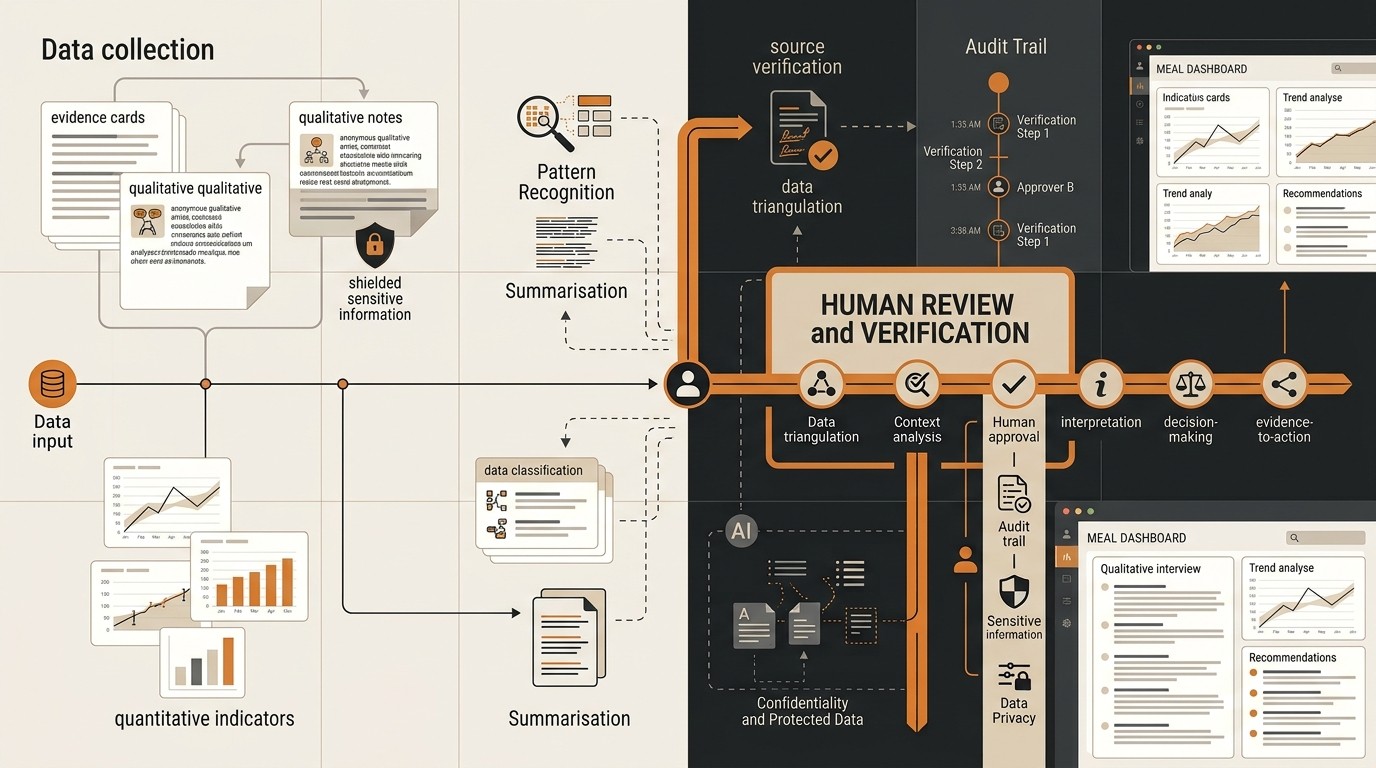
How AI Can Strengthen MEAL Without Replacing Human Judgment
Artificial intelligence is rapidly becoming part of everyday work in international development.
Programme teams can now use AI to summarise hundreds of pages of documents, review indicators, organise qualitative responses, identify unusual patterns in datasets, compare monitoring results, draft reporting language, translate technical information and search large collections of organisational knowledge.
For Monitoring, Evaluation, Accountability and Learning teams, this creates a significant opportunity.
It also creates a serious risk.
MEAL is not simply about processing information. It is about determining whether evidence is credible, understanding what that evidence means in a particular context, recognising whose perspectives may be missing, questioning assumptions, protecting the people whose data we collect and helping organisations make responsible decisions.
Those responsibilities cannot simply be handed to an algorithm.
The most useful question is therefore not:
Can AI replace some of our MEAL work?
It is:
Where can AI reduce repetitive work and strengthen analysis without weakening human judgment, accountability or evidence quality?
A responsible approach to AI in MEAL should be built around one simple principle:
Automate repetitive work. Accelerate analysis. Keep judgment and accountability human.
This article explains what that principle looks like in practice and provides concrete workflows, prompts and safeguards that MEAL teams can start using today.
What Does AI for MEAL Actually Mean?
When people discuss artificial intelligence in MEAL, they sometimes imagine sophisticated predictive systems, automated evaluations or algorithms making programme decisions.
Most organisations do not need anything that complicated.
The immediate opportunity is much more practical.
Generative AI and related analytical tools can support activities such as:
reviewing programme logic and Theories of Change;
checking indicators before implementation;
summarising monitoring reports;
organising qualitative evidence;
detecting possible data anomalies;
comparing results across locations or reporting periods;
generating questions for programme reflection;
searching organisational knowledge;
drafting evidence-based reporting language;
translating technical information for different audiences;
helping teams identify gaps in the evidence they already have.
Some international organisations are already experimenting with these approaches. UNDP's Independent Evaluation Office, for example, has introduced generative AI capabilities into its AIDA platform to help users organise and explore large bodies of evaluative evidence.
The important word is support.
AI can process information.
MEAL professionals must still determine whether the information is trustworthy, relevant, sufficient and appropriate for the decision being made.
AI Should Augment MEAL, Not Automate Accountability
There is an important difference between automation and augmentation.
Automation asks:
Can technology perform this task instead of a person?
Augmentation asks:
Can technology help a person perform this task faster, more consistently or with greater analytical depth?
For many MEAL functions, augmentation is the better model.
Imagine a programme that receives 1,500 open-ended beneficiary comments.
A MEAL officer could manually read every response, identify themes, develop categories, code the responses and prepare a thematic analysis.
AI could help accelerate the early stages by proposing possible themes, grouping similar responses and identifying unusual or contradictory comments.
But the human analyst should still decide:
whether the categories make sense;
whether important minority perspectives have been lost;
whether local terminology has been misunderstood;
whether frequency of mention actually indicates importance;
whether some responses require safeguarding attention;
whether power dynamics affected what respondents were willing to say;
whether the available evidence supports the conclusion being made.
The AI has helped organise evidence.
It has not replaced the evaluator.
This distinction is essential because international responsible-AI frameworks increasingly emphasise human oversight, accountability, privacy, transparency and the protection of fundamental rights.
Seven Ways AI Can Strengthen MEAL Today
1. Challenge a Theory of Change Before Implementation
A Theory of Change can appear convincing because the people who designed it already understand what they intended.
AI can serve as a structured challenger.
Suppose a programme assumes:
Training → Improved knowledge → Changed professional behaviour → Improved public services
At first glance, this looks reasonable.
But several critical questions remain.
Does increased knowledge actually lead to changed behaviour?
Do participants have the authority to apply what they learned?
Are there organisational incentives that encourage or discourage the new behaviour?
Do supervisors support the change?
Are sufficient resources available?
Could political, institutional or cultural factors interrupt the pathway?
Could the intervention produce unintended results?
AI can help programme teams systematically interrogate these assumptions before implementation begins.
Practical prompt: Theory of Change reviewer
Act as a senior MEAL adviser reviewing the Theory of Change below.
Do not rewrite it initially.
Identify:
weak or unexplained causal links;
assumptions required for each major transition;
important external factors that could influence results;
plausible unintended positive and negative outcomes;
groups that may experience the intervention differently;
evidence required to test the most important assumptions; and
assumptions suitable for routine monitoring versus deeper evaluation.
For every criticism, explain your reasoning.
Do not invent contextual facts that have not been provided.
This output should then be reviewed by people who understand the intervention and its operating context.
AI can make assumptions easier to see.
It cannot determine whether those assumptions accurately reflect reality.
2. Improve Indicators Before Data Collection Begins
AI can provide a useful first review of an indicator framework.
Consider this indicator:
Number of government officials trained
This may be a perfectly valid output indicator.
But suppose the intended outcome is:
Government officials apply improved financial-management practices.
Training attendance alone does not demonstrate that outcome.
The problem is not that the indicator is wrong.
The problem is using an output indicator to make an outcome claim.
AI-assisted review can help teams ask whether each indicator is:
aligned with the intended result;
clearly defined;
measurable;
sufficiently sensitive to change;
realistically collectable;
appropriately disaggregated;
vulnerable to misinterpretation;
likely to create unintended incentives;
useful for programme decisions.
Practical prompt: Indicator quality reviewer
Act as a senior MEAL specialist.
Review the following result statement and proposed indicators.
For each indicator assess:
alignment with the intended result;
result level: activity, output, outcome or impact;
clarity;
validity;
reliability;
feasibility;
appropriate disaggregation;
potential data-quality risks;
possible unintended incentives;
usefulness for programme management.
Explain what each indicator can legitimately tell us and what it cannot tell us.
Do not propose additional indicators unless you identify a genuine measurement gap.
Explain every recommendation.
The final indicator framework should still be agreed by people who understand the programme, data environment, donor requirements and management needs.
3. Strengthen Data-Quality Checks
One of the most useful applications of AI is not producing conclusions.
It is identifying questions that deserve investigation.
Imagine a monitoring dataset where:
one location reports 100 percent attendance for 18 consecutive activities;
several respondents have identical narrative answers;
an outcome indicator improves by 70 percent in one month;
dates appear inconsistent with programme implementation;
dozens of forms were completed in almost exactly the same amount of time;
one population group has significantly higher missing data than others;
the denominator used for an indicator changes unexpectedly between quarters.
None of these observations proves that the data are wrong.
They are signals.
AI can help surface those signals in datasets too large for a human reviewer to inspect record by record.
The appropriate workflow is:
AI flags → Human investigates → Source evidence is checked → Team decides
Not:
AI flags → Data are declared invalid
Practical prompt: Data-quality challenger
Examine the following anonymised dataset or dataset summary for potential data-quality concerns.
Look for:
missing values;
contradictory values;
duplicate patterns;
unusual distributions;
improbable changes between periods;
suspicious uniformity;
inconsistent dates;
denominator inconsistencies;
unexpected differences between locations or groups.
Do not state that any value is incorrect unless the evidence proves it.
Classify each observation as:
Requires verification
Possible concern
No obvious concern
For every flagged issue, recommend a practical verification step.
This makes AI a quality-control assistant rather than a judge.
4. Make Qualitative Analysis More Manageable
MEAL systems often underuse qualitative evidence because analysing it takes time.
Organisations may have hundreds or thousands of:
open-ended survey responses;
beneficiary interviews;
focus-group discussions;
field-monitoring notes;
outcome stories;
complaints;
community feedback records;
partner reports;
observation notes.
AI can help organise these materials by proposing preliminary codes, grouping similar themes, comparing responses across locations, identifying contradictory evidence and surfacing unusual cases.
That can be extremely useful.
But qualitative analysis is also one of the areas where human interpretation matters most.
A statement can mean something different depending on:
who said it;
who was present;
the language used;
local terminology;
social norms;
gender and power relations;
political context;
interviewer behaviour;
what the respondent felt safe saying;
what remained unsaid.
An AI system sees text.
A skilled qualitative researcher interprets text within context.
That distinction should never disappear.
A Responsible AI-Assisted Qualitative Analysis Workflow
Suppose a livelihoods evaluation includes 400 de-identified interview responses.
A responsible workflow could look like this.
Step 1: Start With the Evaluation Question
Do not begin with:
What themes exist in these interviews?
Begin with the substantive evaluation question.
For example:
What factors appear to influence whether participants translate training into improved livelihood outcomes?
The analytical objective should guide the technology.
Step 2: Prepare the Data Safely
Remove information that the AI system does not need.
Depending on the context, this may include:
names;
telephone numbers;
addresses;
identification numbers;
exact GPS locations;
detailed medical information;
protection information;
safeguarding information;
political opinions;
highly sensitive demographic characteristics;
other information that could identify an individual.
Do not assume that removing a person's name automatically makes a dataset anonymous.
A combination of location, occupation, age, household composition and programme participation may still make someone identifiable.
Step 3: Ask AI to Propose an Exploratory Coding Structure
The AI can suggest initial categories.
Treat this as a starting point.
Not as the final codebook.
Step 4: Human Researchers Review the Codes
The research team should:
merge overlapping categories;
reject weak categories;
add locally meaningful concepts;
identify sensitive themes;
define coding rules;
clarify ambiguous concepts.
This is where contextual expertise becomes essential.
Step 5: Use the Approved Framework for Assisted Coding
Once the coding structure is approved, AI can help organise larger volumes of material.
This can reduce the amount of repetitive manual classification required.
Step 6: Validate Samples Manually
Human analysts should independently review samples of the coding.
Do not examine only obvious examples.
Include ambiguous and borderline cases.
If the AI consistently misclassifies a particular concept, revise the workflow.
Step 7: Examine Contradictions and Minority Perspectives
The most frequently mentioned theme is not automatically the most important finding.
A smaller number of responses may reveal:
an exclusion problem;
a safeguarding concern;
an unintended negative outcome;
a particular barrier affecting a marginalised group;
an implementation failure in one location.
AI-assisted analysis should therefore actively search for deviant cases and contradictory evidence, not merely dominant patterns.
Step 8: Triangulate
Compare qualitative findings with:
quantitative data;
routine monitoring evidence;
programme records;
contextual information;
other stakeholder perspectives;
relevant secondary evidence.
No important evaluation conclusion should depend solely on an AI-generated thematic summary.
Step 9: Human Analysts Interpret the Findings
This is where meaning is established.
AI may help organise evidence.
Humans remain responsible for deciding what that evidence means.
5. Turn Monitoring Data Into Management Questions
Many development organisations do not suffer from a lack of data.
They suffer from a lack of usable evidence.
Dashboards contain dozens of indicators.
Quarterly reports contain hundreds of numbers.
Databases contain thousands of records.
Yet programme managers may still struggle to answer:
What needs my attention this month?
AI can help bridge this gap.
Imagine providing an approved analytical system with:
current indicator values;
targets;
previous reporting periods;
implementation notes;
complaints trends;
relevant qualitative observations;
risk information.
Instead of asking:
Is the programme performing well?
ask:
Which patterns require management attention, and what questions should we investigate?
The system might identify:
Indicator A: Below expected trajectory for three consecutive months.
Indicator B: Overall target achieved, but one geographic area is significantly behind.
Indicator C: Quantitative performance is strong, while participant feedback suggests declining service quality.
Indicator D: Target exceeded, but the denominator changed between reporting periods.
The AI has not decided what management should do.
It has helped identify where management should look more carefully.
That is a much more appropriate role.
6. Improve Reporting Without Inventing Evidence
Generative AI can produce polished text remarkably quickly.
That creates temptation.
Upload some numbers.
Ask for a donor report.
Copy the result.
This can introduce unsupported claims into MEAL reporting surprisingly easily.
Generative AI systems can produce information that sounds convincing while being incorrect, unsupported or invented.
For MEAL, this means reporting prompts should be evidence constrained.
Avoid this
Write an analysis of our quarterly programme performance.
Use this instead
Using only the evidence supplied below, draft an analysis of programme performance.
For every substantive conclusion:
identify the evidence supporting it;
distinguish observed fact from interpretation;
identify contradictory evidence;
flag missing information;
do not infer causality unless the evidence supports it;
do not invent explanations for changes;
identify statements requiring programme-team validation.
If evidence is insufficient for a conclusion, state:
Insufficient evidence to conclude.
End with a separate section titled:
Questions for Human Review.
This changes AI from a report generator into a structured drafting assistant.
That difference matters.
7. Build Organisational Memory From Evaluations and Learning
Perhaps the most transformative application of AI for MEAL is also one of the least glamorous:
finding what the organisation already knows.
Development organisations produce enormous quantities of evidence.
Evaluations.
Baselines.
Endlines.
Monitoring reports.
Research studies.
Learning briefs.
After-action reviews.
Partner assessments.
Third-party monitoring reports.
Community feedback.
Yet knowledge is often lost when staff leave, projects close or documents disappear into shared folders.
An internal evidence system could allow a team to ask questions such as:
What did our last five evaluations identify as barriers to women's participation?
Which recommendations about partner capacity appeared repeatedly?
What assumptions failed across previous livelihoods programmes?
What evidence do we already have about this intervention model?
Which evaluation recommendations remain unresolved?
The important design principle is that the system should retrieve and point back to evidence, not produce an authoritative answer disconnected from the underlying sources.
This could fundamentally improve organisational learning.
Knowledge becomes more valuable when it can be retrieved at the moment a decision is being made.
What Should AI Not Decide in MEAL?
Not every MEAL task carries the same level of risk.
A useful starting point is to distinguish low-consequence assistance from high-consequence judgment.
Generally appropriate for AI assistance
AI can often support:
formatting non-sensitive monitoring notes;
summarising approved documents;
checking indicator wording;
suggesting improvements to survey questions;
comparing reporting periods;
flagging possible data anomalies;
preparing preliminary qualitative codes;
drafting text from verified evidence.
Human review is still required.
Appropriate only with strong controls
Greater caution is needed when AI is used for:
qualitative analysis;
monitoring-dataset analysis;
beneficiary feedback analysis;
complaint trend analysis;
evaluation synthesis;
translation of sensitive narratives;
substantive donor-report analysis;
interpretation of complex programme evidence.
These uses may require:
approved tools;
data minimisation;
de-identification;
documented methods;
human validation;
source verification;
clear acknowledgement of limitations.
Decisions that should remain human
Generative AI should not independently determine:
beneficiary eligibility;
whether a complaint is credible;
safeguarding action;
protection case prioritisation;
disciplinary action;
whether an intervention caused an outcome;
final evaluation judgments;
high-consequence decisions affecting individuals;
interpretation of highly sensitive testimony.
AI might support limited administrative or analytical tasks surrounding these processes.
It should not inherit the accountability attached to the decision.
The Most Important AI Question in MEAL May Be About Data, Not Prompts
The easiest way to use AI badly is often not writing a bad prompt.
It is giving the system information it should never have received.
MEAL teams routinely handle sensitive information, including:
beneficiary names;
telephone numbers;
locations;
household information;
disability information;
health information;
complaints;
safeguarding records;
protection cases;
migration information;
political information;
interview transcripts;
photographs;
identifying narratives.
Before uploading programme information to an external AI system, organisations should ask:
What information are we sending?
Do we actually need to send it?
Does it contain personal or sensitive data?
Could individuals still be identified even if their names are removed?
Where will the information be processed?
Will it be retained?
Who may have access to it?
What contractual safeguards exist?
Is this use permitted under our organisational policies?
Would the people who provided the information reasonably expect it to be used in this way?
The safest operational principle is straightforward:
Do not give an AI system more data than it needs to perform the task.
Sometimes aggregated data are enough.
Sometimes de-identified data are enough.
Sometimes synthetic examples can be used.
And sometimes AI should not be used for the task at all.
The Mizan Evidence HUMAN Review for AI-Assisted MEAL
Organisations do not need to become AI laboratories before using these tools responsibly.
But they do need discipline.
Before using AI for a meaningful MEAL task, apply five checks.
H: Human Accountability
Ask:
Who is accountable for the final product or decision?
There should always be a named human owner.
AI does not approve an evaluation finding.
AI does not sign a donor report.
AI does not decide whether evidence is sufficient.
A person does.
U: Use Case
Define the task precisely.
Weak:
Use AI to analyse our programme.
Better:
Use AI to identify potentially contradictory responses in this anonymised monitoring dataset for human verification.
The more clearly a task is defined, the easier it becomes to identify appropriate controls.
M: Minimise Data
Provide only the information necessary for the task.
Remove unnecessary identifying information.
Do not upload entire datasets simply because doing so is convenient.
Ask whether aggregated, de-identified or synthetic information could accomplish the same objective.
A: Assess and Verify
Never assume an output is correct simply because it sounds professional.
Verification may include:
checking calculations;
reviewing source documents;
manually coding a sample;
testing alternative prompts;
examining contradictory evidence;
asking another analyst to review important conclusions;
confirming quotations against transcripts;
checking whether references actually exist.
The more consequential the output, the stronger the verification should be.
N: Note and Document
For material uses of AI, document what was done.
For example:
AI-assisted preliminary thematic coding was used to organise de-identified interview responses. The evaluation team developed the final codebook, manually validated a sample of coded responses and retained responsibility for interpretation and findings.
Documentation supports transparency, reproducibility and organisational learning.
It also helps future teams understand how evidence was produced.
A Practical AI Traffic-Light for MEAL Teams
A simple traffic-light model can help organisations decide how much control a particular use case requires.
GREEN: Generally Suitable for AI Assistance
Examples include:
brainstorming evaluation questions;
improving indicator wording;
summarising non-sensitive internal documents;
converting technical language into plain language;
organising approved secondary evidence;
generating questions for learning meetings;
preparing first drafts from verified evidence.
Normal human review remains necessary.
AMBER: Use With Stronger Controls
Examples include:
qualitative coding;
analysing monitoring datasets;
synthesising evaluation evidence;
translating beneficiary narratives;
identifying data anomalies;
preparing substantive report analysis;
analysing feedback and complaint trends.
Additional safeguards should include:
approved tools;
data minimisation;
de-identification where necessary;
documented methods;
human validation;
source verification;
explicit acknowledgement of limitations.
RED: Do Not Delegate the Decision to Generative AI
Examples include:
safeguarding decisions;
determining complaint credibility;
individual beneficiary eligibility;
protection case prioritisation;
disciplinary action;
final evaluation judgments;
decisions based on highly sensitive personal data without appropriate governance;
causal conclusions unsupported by appropriate evaluation design.
Technology may support parts of the workflow.
The decision and accountability should remain human.
Five Practical AI Prompts for MEAL Professionals
Prompt 1: Indicator Quality Reviewer
Act as a senior MEAL specialist.
Review the indicator framework below.
For every indicator assess:
alignment with the intended result;
result level;
clarity;
validity;
reliability;
feasibility;
data source;
numerator and denominator where applicable;
disaggregation;
data-quality risks;
usefulness for management.
Identify what the indicator can legitimately tell us and what it cannot tell us.
Do not assume information that has not been provided.
Prompt 2: Data-Quality Challenger
Analyse the following anonymised monitoring data for patterns requiring verification.
Do not classify a value as incorrect solely because it is unusual.
Look for:
missingness;
duplicates;
improbable combinations;
inconsistent dates;
unusual distributions;
sharp unexplained changes;
denominator inconsistencies;
suspicious uniformity.
Present findings in three categories:
Requires verification
Possible concern
No obvious concern
Recommend a verification action for every flagged issue.
Prompt 3: Qualitative Evidence Analyst
Conduct an exploratory thematic analysis of the de-identified responses below.
First propose a coding structure.
Then identify:
dominant themes;
minority perspectives;
contradictory evidence;
unusual cases;
differences between relevant groups where evidence allows;
questions requiring contextual interpretation.
Do not treat frequency as equivalent to importance.
Do not invent quotations.
Distinguish clearly between what respondents said and your interpretation.
Prompt 4: Programme Learning Facilitator
Review the evidence below in preparation for a programme learning meeting.
Identify:
what appears to be working;
what appears not to be working;
unexpected results;
important differences between groups or locations;
assumptions that should be revisited;
contradictions in the evidence;
information we still need;
five questions management should discuss.
Do not recommend programme changes where the evidence is insufficient.
Prompt 5: Evaluation Finding Verifier
Review the proposed evaluation finding against the evidence supplied.
Rate the finding as:
Strongly supported
Moderately supported
Weakly supported
Contradicted
Impossible to assess
Explain the rating.
Identify which evidence supports the finding, which evidence challenges it and what additional evidence would be required to increase confidence.
Do not introduce evidence that has not been supplied.
AI Verification Checklist
Before AI-assisted analysis is used in a report, presentation or programme decision, ask:
Does every important conclusion trace back to real evidence?
Did the system introduce facts that were not supplied?
Were calculations independently checked?
Were quotations verified against their original source?
Did we examine contradictory evidence?
Could contextual nuance have been lost?
Could an underrepresented group have been overlooked?
Did we confuse correlation with causality?
Were sensitive data appropriately protected?
Would a knowledgeable human reviewer agree with the interpretation?
Have important uncertainties been communicated?
Can we explain how AI contributed to the analysis?
If several answers are no, the output is not ready for use.
AI Will Not Fix a Weak MEAL System
This may be the most important point in this article.
AI cannot repair unclear programme logic simply by generating more indicators.
It cannot make poor-quality data reliable by producing a better dashboard.
It cannot create accountability if communities are not being heard.
It cannot turn reporting into learning if management never discusses the evidence.
It cannot establish causality simply because a prompt asks it to.
It cannot replace contextual knowledge.
And it cannot compensate for an organisation that has not decided what evidence it actually needs.
In fact, adding AI to a weak MEAL system can make existing weaknesses harder to detect.
Poor evidence can now be transformed into polished-looking outputs faster than ever before.
A professional-looking paragraph does not make an unsupported conclusion more credible.
A sophisticated dashboard does not make inaccurate data more reliable.
A beautifully summarised evaluation does not make a weak methodology stronger.
The correct sequence is:
Clear programme logic
↓
Fit-for-purpose indicators and learning questions
↓
Responsible data collection
↓
Data quality
↓
Analysis
↓
Human interpretation
↓
Decision and adaptation
↓
AI where it genuinely strengthens the process
Not the other way around.
Will AI Replace MEAL Professionals?
Probably the wrong question.
Parts of MEAL work will undoubtedly become easier to automate.
Manual transcription.
Basic categorisation.
Formatting.
Document comparison.
Routine synthesis.
First-draft reporting.
Some data-quality checks.
Those tasks may require significantly less human time.
But the value of strong MEAL professionals lies elsewhere.
They understand:
programme logic;
evaluation design;
measurement;
qualitative and quantitative evidence;
sampling;
bias;
context;
stakeholder perspectives;
accountability;
data quality;
ethical risk;
organisational decision-making.
AI makes those competencies more important, not less.
If generating analysis becomes easier, organisations need people who can distinguish strong analysis from plausible nonsense.
If producing indicators becomes easier, organisations need people who know which indicators are meaningful.
If summarising interviews becomes easier, organisations need people who understand what those summaries may have missed.
If reports become easier to write, organisations need people who know whether the claims are justified.
The future MEAL professional is therefore not simply someone who knows how to use AI.
It is someone who knows when to use it, how to verify it, what questions to ask and when not to use it at all.
Frequently Asked Questions
Can NGOs Use ChatGPT or Other Generative AI Tools for MEAL?
Yes. Generative AI can support many MEAL tasks, but organisations should first consider data sensitivity, approved technology, privacy, information security, verification requirements and internal policies.
Sensitive beneficiary information should never be entered into an external AI system simply because doing so is convenient.
The tool must be appropriate to the data and the task.
Can AI Analyse Qualitative Data?
Yes, AI can assist with exploratory coding, thematic grouping, comparison and evidence organisation.
However, human researchers should still develop or validate the analytical framework, review samples, examine contradictory evidence and interpret findings within context.
AI can accelerate qualitative analysis.
It should not remove the researcher from it.
Can AI Write an Evaluation Report?
AI can assist with drafting and organising report content, particularly when it is tightly constrained to verified evidence.
It should not independently determine evaluation findings, invent explanations, infer causality without evidence or replace evaluator judgment.
The report remains the responsibility of the evaluation team.
Can AI Identify Data-Quality Problems?
AI can help identify anomalies, inconsistencies and unusual patterns.
However, an anomaly is not automatically an error.
Source verification and human investigation remain necessary.
Should Beneficiary Data Be Uploaded to Generative AI?
Not automatically.
Organisations should first assess necessity, sensitivity, legal and organisational data-protection requirements, tool security, data retention, access controls and relevant internal policies.
Data minimisation and de-identification should be considered wherever appropriate.
For some sensitive data, the correct decision may simply be not to use an external generative AI tool.
Can AI Replace Community Consultation?
No.
AI can analyse what people have already said.
It cannot replace meaningful engagement with the people affected by a programme.
Accountability requires dialogue, participation, accessible feedback mechanisms and the opportunity for communities to influence decisions.
A model cannot substitute for those relationships.
Will AI Replace MEAL Officers?
AI is more likely to change the composition of MEAL work than eliminate the need for MEAL expertise.
Repetitive processing tasks may become faster.
Skills involving evidence judgment, contextual analysis, evaluation design, ethics, verification, facilitation and decision support are likely to become even more valuable.
Final Takeaway
AI can make MEAL faster.
The more important opportunity is to make MEAL better.
Used responsibly, AI can help teams:
interrogate programme logic;
improve indicators;
identify data-quality concerns;
organise qualitative evidence;
synthesise monitoring information;
retrieve organisational knowledge;
improve reporting;
ask better learning questions.
But technology should remain inside a system of human accountability.
The objective is not to create an AI evaluator.
It is to give qualified people better tools for generating, understanding and using credible evidence.
The principle is therefore worth repeating:
Automate repetitive work. Accelerate analysis. Strengthen learning. Keep judgment and accountability human.
Mizan Evidence Perspective
Organisations considering AI for MEAL should start with the evidence problem, not the technology.
Before choosing a tool, ask:
Where are we spending unnecessary time?
Where are important findings being missed?
Where is evidence failing to reach decision-makers?
Where could stronger analysis improve implementation?
Which parts of our work genuinely require human interpretation?
What new risks would AI introduce?
Only after these questions are answered should an organisation decide where AI belongs in its MEAL system.
AI should not make a weak evidence system look more sophisticated.
It should make a strong evidence system more useful.
Is Your MEAL System Ready to Make Better Use of Evidence?
AI works best when the fundamentals are already functioning: clear programme logic, meaningful indicators, reliable data, accountability mechanisms and evidence-informed decision-making.
Assess your MEAL system to identify strengths, gaps and practical priorities for improvement.
ASSESS YOUR MEAL SYSTEM
Sources & Further Reading
UNESCO
Recommendation on the Ethics of Artificial Intelligence
A global framework addressing human rights, human oversight, privacy, transparency, fairness and accountability in AI.
National Institute of Standards and Technology (NIST)
Artificial Intelligence Risk Management Framework: Generative Artificial Intelligence Profile, NIST AI 600-1
Practical guidance addressing generative AI risks including inaccurate outputs, privacy, harmful bias and information integrity.
OECD
OECD AI Principles
International principles promoting innovative, trustworthy and human-centred artificial intelligence.
International Committee of the Red Cross (ICRC)
Handbook on Data Protection in Humanitarian Action
Guidance on responsible handling of personal data in humanitarian contexts, including risks associated with artificial intelligence and machine learning.
International Committee of the Red Cross (ICRC)
The ICRC's Policy on Artificial Intelligence
An institutional framework for responsible AI use in humanitarian action.
UNICEF Evaluation Office
An Operational Framework for Machine Learning in Evaluation
Practical guidance on machine learning and artificial intelligence in evaluation, including ethics, data handling and methodological considerations.
UNDP Independent Evaluation Office
Artificial Intelligence for Development Analytics (AIDA)
An example of using AI to improve access to and exploration of evaluative evidence.