Guide
10 Signs Your MEAL System Needs Strengthening
A practical diagnostic guide to identifying weaknesses in your MEAL system, from unclear indicators and unreliable data to weak accountability, learning and evidence use.
Mizan Evidence
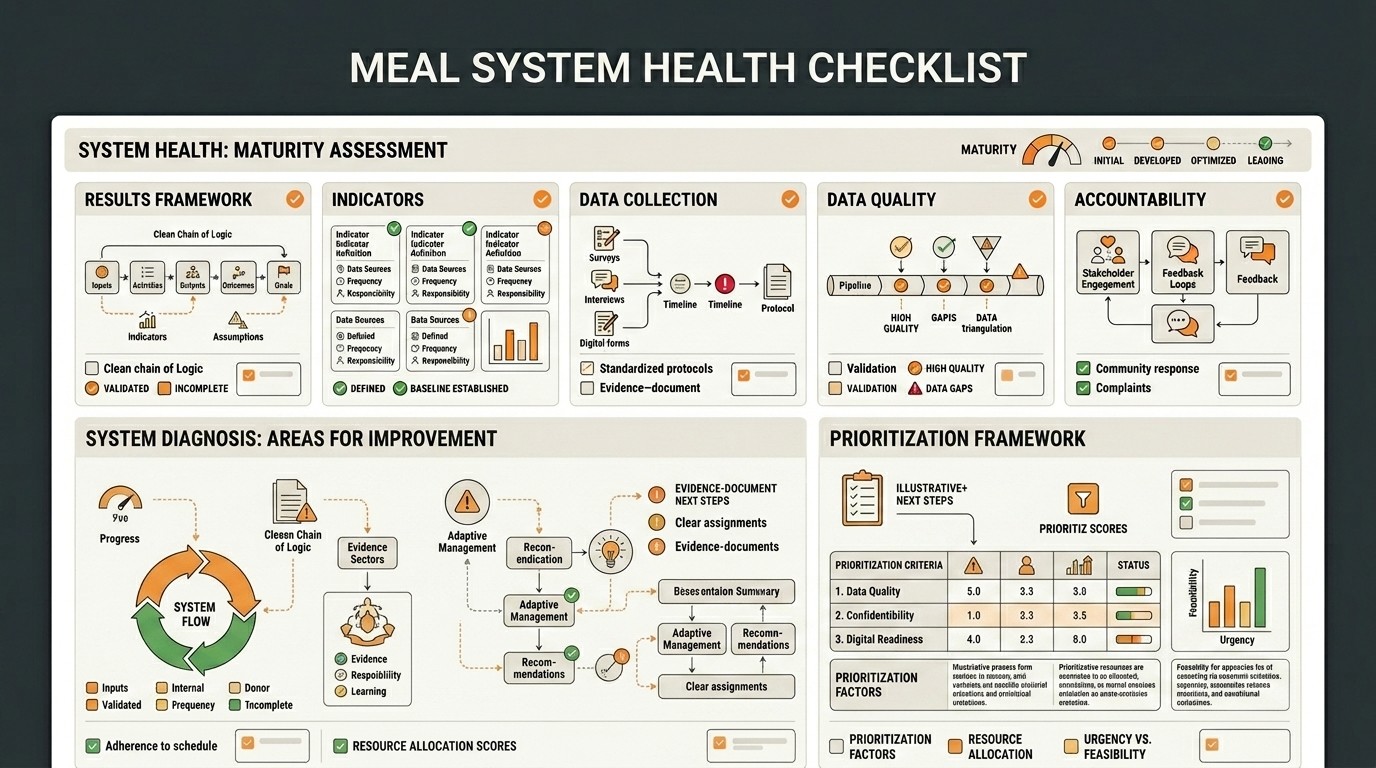
10 Signs Your MEAL System Needs Strengthening
A programme can have a logframe, indicators, Kobo forms, dashboards, quarterly reports and a dedicated MEAL officer and still have a weak MEAL system.
That may sound contradictory.
But having MEAL tools is not the same as having a functioning MEAL system.
A strong Monitoring, Evaluation, Accountability and Learning system connects programme design, evidence collection, analysis, reflection and decision-making.
In simple terms, it should help an organisation answer five questions:
What are we trying to change?
How will we know whether change is happening?
Can we trust the evidence?
What are communities and stakeholders telling us?
What should we do differently because of what we are learning?
When those connections are weak, MEAL can gradually become a reporting function rather than a management and learning function.
The organisation continues collecting information.
Reports continue being produced.
Indicators continue being updated.
But the evidence has less and less influence on implementation.
This article identifies ten common warning signs that a MEAL system needs strengthening, explains why each problem matters, and provides practical actions organisations can take to improve it.
A healthy MEAL system does not simply produce more data. It helps an organisation see earlier, understand better and make stronger decisions.
What Is a MEAL System?
Before looking at the warning signs, it is useful to clarify what we mean by a MEAL system.
MEAL stands for:
Monitoring
Routine tracking of implementation, outputs, outcomes, risks and other information needed to understand programme performance.
Evaluation
Systematic assessment of a programme's relevance, coherence, effectiveness, efficiency, impact and sustainability, or other appropriate evaluation questions.
Accountability
Processes that allow communities, participants and other stakeholders to receive information, provide feedback, raise concerns and influence programmes that affect them.
Learning
Using evidence, experience and reflection to improve implementation, strategy and future programming.
These functions should not operate independently.
A strong MEAL system connects them.
A simplified evidence pathway looks like this:
Programme logic
↓
Indicators and learning questions
↓
Data collection
↓
Data quality
↓
Analysis
↓
Community and stakeholder perspectives
↓
Reflection
↓
Decision
↓
Adaptation
↓
Learning for the next cycle
If several links in that chain are weak, the system may generate information without generating meaningful evidence use.
Sign 1: MEAL Becomes Important Only When a Donor Report Is Due
This is one of the easiest weaknesses to recognise.
For several weeks, monitoring receives limited attention.
Then the reporting deadline approaches.
Suddenly:
programme teams search for missing numbers;
field staff are asked to update trackers;
MEAL staff chase incomplete forms;
indicator values are consolidated;
narrative explanations are drafted;
and everyone works intensively to complete the donor report.
The report is submitted.
Then attention shifts back to programme implementation until the next reporting deadline.
This is a reporting cycle.
It is not a strong MEAL cycle.
Why this matters
Monitoring information is most valuable while there is still time to respond.
Imagine an employment programme discovers during its annual report that participant dropout has been increasing for nine months.
The information may be accurate.
But it arrived too late.
A stronger system might have identified the trend after two months and asked:
Why are participants leaving?
Is dropout concentrated among women?
Is transport becoming unaffordable?
Are sessions taking place at unsuitable times?
Has programme quality changed?
Could the delivery model be adapted?
The purpose of monitoring is not simply to explain what happened after implementation.
It should help teams recognise when implementation is moving away from expectations.
What stronger practice looks like
Create routine evidence-review moments between donor reports.
These do not need to become large meetings.
A monthly or quarterly programme review can focus on questions such as:
What changed?
What surprised us?
Where are results below expectations?
Which groups are experiencing different outcomes?
What feedback are we receiving?
What needs investigation?
What decision should follow?
When MEAL becomes part of management rather than an activity performed before reporting deadlines, the system becomes far more useful.
Sign 2: You Collect Indicators Nobody Uses
Ask your programme team a simple question:
Which management decision does this indicator help us make?
Some indicators will have an obvious answer.
Others will not.
Development programmes often accumulate indicators over time.
A donor requests several.
The organisation adds internal indicators.
Technical teams add more.
A partner introduces additional reporting requirements.
Another indicator is created because somebody thinks the information might be useful later.
Eventually a relatively small programme may be tracking dozens of indicators.
Across an organisation, this can become hundreds.
The result is a hidden cost.
Every indicator requires some combination of:
data collection;
staff time;
data entry;
verification;
analysis;
storage;
reporting;
and respondent effort.
More indicators do not automatically mean stronger MEAL
An indicator should usually exist for a reason.
That reason may be:
a contractual reporting requirement;
programme management;
accountability;
risk monitoring;
learning;
strategic decision-making;
or evidence needed for evaluation.
If nobody can explain why an indicator matters, investigate whether it should remain in the system.
A practical indicator-use test
For every important indicator, ask:
Who uses this information?
How frequently do they need it?
What decision could it influence?
What would we do if performance deteriorated?
What would we conclude if the indicator improved?
Could another indicator answer the same question more efficiently?
The objective is not to eliminate indicators simply to reduce workload.
It is to create a measurement framework in which every important indicator has a clear purpose.
Measure what you need to understand and manage the programme, not everything that can technically be counted.
Sign 3: Your System Measures Activities Better Than Change
These indicators will be familiar to almost anyone working in international development:
Number of people trained
Number of workshops conducted
Number of materials distributed
Number of meetings held
Number of organisations supported
Number of awareness sessions delivered
There is nothing inherently wrong with these indicators.
They tell us whether implementation happened.
That matters.
The problem appears when organisations use delivery measures as evidence of change.
Consider a programme whose objective is to improve women's economic opportunities.
It trains 2,000 women.
That is useful output information.
But it does not tell us whether participants:
developed new skills;
applied those skills;
started businesses;
improved existing businesses;
increased income;
gained greater control over economic decisions;
or experienced new barriers.
Outputs answer one question
What did the programme deliver?
Outcomes answer another
What changed?
A healthy MEAL system needs an appropriate balance.
That does not mean every programme needs complicated impact measurement.
It means the monitoring framework should include enough evidence to test whether the programme's underlying logic appears to be working.
A simple results-chain test
Take one major programme intervention.
Write:
We do...
Then:
Participants receive...
Then:
Participants change...
Then:
This contributes to...
For example:
We deliver business coaching
↓
Entrepreneurs receive technical support
↓
Entrepreneurs improve business-management practices
↓
Businesses improve performance
↓
Households may experience stronger economic resilience
Now examine your indicators.
Where are they concentrated?
If nearly all measurement stops at the first two levels, your system may know a great deal about programme delivery and much less about programme results.
Sign 4: Different People Calculate the Same Indicator Differently
Consider this indicator:
Percentage of trained participants applying their new skills.
It sounds straightforward.
Until you start asking questions.
Who counts as trained?
Does somebody need to attend one session or complete the full training?
What qualifies as applying a skill?
Is self-report enough?
Must application be observed?
When should it be measured?
One week later?
Three months later?
Six months later?
What is the numerator?
What is the denominator?
What happens when participants cannot be reached?
Should participants who dropped out remain in the denominator?
If different staff answer these questions differently, you effectively have several indicators sharing the same name.
Why this matters
Indicators create an appearance of precision.
A dashboard may show:
67%
But the number is meaningful only if the organisation understands exactly how it was calculated.
If one office calculates an indicator differently from another, combining the results may produce misleading conclusions.
What stronger practice looks like
Important indicators should have an Indicator Reference Sheet or equivalent definition.
At minimum, define:
Indicator wording
Result level
Purpose
Operational definition
Numerator
Denominator
Unit of measure
Data source
Collection method
Frequency
Disaggregation
Responsible person
Baseline
Target
Known limitations
Data-quality checks
A well-defined indicator allows another trained person to reproduce the calculation.
If that is impossible, the indicator is not sufficiently defined.
Sign 5: Nobody Can Confidently Explain the Quality of the Data
A professional dashboard can create confidence.
That confidence may be misplaced.
A beautifully designed chart is only as credible as the information underneath it.
Common data-quality warning signs include:
different spreadsheets containing different totals;
missing source documentation;
duplicate records;
retrospective data entry;
unexpected gaps;
inconsistent definitions between locations;
implausibly perfect values;
unexplained changes between reporting periods;
and indicator results that cannot be reproduced.
Data quality does not mean perfect data
No real-world dataset is perfect.
The important question is whether the organisation understands:
where the data came from;
how they were collected;
what weaknesses exist;
what checks were performed;
and how much confidence should be placed in the results.
A practical example
Suppose a programme reports:
94% participant satisfaction
That may appear excellent.
But then you discover that:
only 48 percent of participants responded;
responses were collected immediately after receiving assistance;
staff delivering the programme administered the survey;
and participants were not told whether responses were confidential.
The percentage has not mathematically changed.
Your confidence in what it represents should.
Build proportionate data-quality controls
Not every indicator requires the same level of verification.
High-risk indicators may require stronger controls.
Useful checks can include:
source-document verification;
automated validation rules;
duplicate detection;
spot checks;
logic checks;
recalculation;
field supervision;
back-checks;
review of missingness;
and periodic data-quality assessments.
The objective is not to create bureaucracy.
It is to understand whether evidence is reliable enough for the decision being made.
Sign 6: Community Feedback Enters the System but Rarely Comes Back Out
Many organisations now have complaint and feedback mechanisms.
That is positive.
But having a mechanism does not automatically create accountability.
Consider this process:
A community member submits feedback.
The feedback is entered into a database.
A staff member assigns a category.
The case is marked closed.
The organisation reports:
243 feedback cases received and 231 closed.
Operationally, the system may be functioning.
But several important questions remain.
What are people repeatedly telling us?
Are complaints increasing in one location?
Do women and men use the mechanism differently?
Are people with disabilities able to access it?
Which issues remain unresolved?
Are there repeated concerns about staff behaviour?
Do communities know what happened because of their feedback?
Has the programme changed anything?
Accountability requires a feedback loop
A strong system asks three questions:
Can people speak?
Does the organisation listen?
Does anything happen as a result?
Community feedback should therefore be analysed not only case by case but also collectively.
For example:
Twenty individual complaints about waiting times may appear minor when viewed separately.
Together, they may reveal a service-design problem.
Repeated questions about eligibility may indicate poor communication.
Low complaint rates among a particular group may not indicate satisfaction. It may indicate that the mechanism is inaccessible or unsafe for them.
Stronger practice
Periodically analyse feedback by:
type;
location;
population group where appropriate;
severity;
response time;
recurrence;
programme component;
and resolution.
Then discuss the patterns with programme teams.
Accountability becomes meaningful when community perspectives can influence programme decisions.
Sign 7: Reports Are Produced but Decisions Remain Unchanged
This is one of the most important tests of MEAL maturity.
Your organisation may produce excellent reports.
The analysis may be technically strong.
The recommendations may be thoughtful.
But ask:
What changed because of this evidence?
If the answer is consistently unclear, the organisation may have an evidence-use problem.
Evidence does not automatically become a decision
A report can be:
written;
reviewed;
approved;
shared;
uploaded;
and forgotten.
For evidence to influence programming, organisations need deliberate processes connecting analysis to decisions.
A useful four-option framework
When important evidence is reviewed, the team should usually consider one of four responses.
Continue
The evidence supports the current approach.
No major change is required.
Adapt
The evidence suggests implementation should change.
Investigate
The evidence is incomplete, contradictory or uncertain.
More information is required.
Stop
The evidence suggests an intervention is ineffective, inappropriate, harmful or no longer justified.
Not every finding should lead to change.
Sometimes the correct decision is to continue.
But the decision should be informed by evidence rather than habit.
Add a decision tracker
After major reviews, record:
Finding
Decision
Action
Responsible person
Deadline
Follow-up evidence
This simple mechanism can dramatically improve the connection between MEAL and programme management.
Sign 8: The MEAL Officer Owns MEAL
This sounds logical at first.
Surely the MEAL officer should own MEAL?
The MEAL team should own important technical responsibilities.
But the organisation should not outsource its entire evidence culture to one department.
When programme staff say:
Ask MEAL. They handle the indicators.
there may be a deeper problem.
Programme teams should understand:
what results they are trying to achieve;
which indicators reflect those results;
what data they are responsible for producing;
what the latest evidence shows;
and what limitations exist.
Managers should be able to discuss programme results without waiting for the MEAL officer to interpret every number.
Field staff should understand why information is being collected.
Senior leadership should ask evidence questions.
Technical advisers should contribute to interpretation.
MEAL should enable ownership, not absorb it
A mature MEAL team performs roles such as:
designing systems;
protecting measurement quality;
supporting analysis;
building staff capacity;
facilitating learning;
challenging weak conclusions;
and strengthening evidence use.
It should not become the only part of the organisation that understands the evidence.
MEAL is a technical function, but evidence use is an organisational responsibility.
Sign 9: Learning Exists Mainly as a Section in Reports
Many programme reports contain a section titled:
Lessons Learned
The existence of this heading does not mean organisational learning has occurred.
Consider the difference.
Observation
Participants had difficulty attending afternoon sessions because of transport constraints.
Lesson
Scheduling affects equitable participation.
Decision
Move future sessions closer to participant communities and test alternative timing.
Action
The programme changes its delivery model.
Follow-up
Attendance improves, particularly among previously underrepresented participants.
That is a learning loop.
The full process is:
Evidence → Reflection → Decision → Action → Follow-up
Without the later steps, a lesson remains an observation.
Structured learning does not need to be complicated
Useful mechanisms include:
quarterly learning reviews;
after-action reviews;
implementation retrospectives;
pause-and-reflect sessions;
evaluation recommendation trackers;
programme adaptation logs;
cross-project learning sessions.
The critical element is not the meeting format.
It is whether evidence changes future behaviour.
Sign 10: The MEAL System Cannot Adapt When the Programme Changes
Programmes rarely operate exactly as originally designed.
Contexts change.
Assumptions fail.
New risks emerge.
Participants behave differently than expected.
Activities evolve.
Funding changes.
Implementation models are adapted.
Unexpected outcomes appear.
Yet some MEAL frameworks remain frozen because they were approved at proposal stage.
This creates an important disconnect.
The programme operating today may no longer be the programme described by the measurement framework.
A MEAL system requires both stability and flexibility
Indicators should not change casually every few weeks.
Consistency matters for analysing trends.
But the system should be able to respond when the programme fundamentally changes.
That may involve:
revisiting the Theory of Change;
updating assumptions;
refining indicator definitions;
adding a learning question;
changing data-collection frequency;
introducing qualitative inquiry;
monitoring a new risk;
or revising a target where circumstances have materially changed.
A strong MEAL system is stable enough to measure progress and flexible enough to remain relevant.
A Five-Question Test for Your MEAL System
Here is a quick diagnostic exercise.
Ask several programme and management staff these questions separately.
Do not allow them to open the latest donor report first.
Question 1
What are the three most important changes this programme is trying to achieve?
If answers differ significantly between staff, the programme logic may not be sufficiently shared.
Question 2
What evidence tells us whether those changes are happening?
If the answer focuses almost entirely on activities, outcome measurement may need strengthening.
Question 3
What important uncertainty do we still have about the programme?
Strong programmes should be able to articulate what they do not yet know.
Question 4
What has evidence caused us to change during the last six months?
If nobody can identify an example, examine whether MEAL information is reaching decisions.
Question 5
What are communities telling us that our indicators do not?
If nobody knows, accountability and qualitative evidence may be disconnected from programme management.
These five questions can reveal more about MEAL maturity than a large collection of templates.
Do You Need More MEAL or Better MEAL?
When organisations identify weaknesses, the instinct is often to add things.
More indicators.
More surveys.
More dashboards.
More forms.
More reporting templates.
More software.
More meetings.
Sometimes that is necessary.
Often it is not.
Strengthening a MEAL system can also mean:
removing indicators nobody uses;
shortening a data-collection form;
clarifying one important outcome;
improving one indicator definition;
consolidating duplicate databases;
establishing a quarterly evidence review;
analysing community feedback systematically;
clarifying staff responsibilities;
strengthening data-quality checks;
or making evaluation recommendations easier to follow.
The objective is not to build the largest possible MEAL system.
It is to build a fit-for-purpose system capable of generating credible evidence for the decisions the organisation actually needs to make.
A Practical 30-Day MEAL Strengthening Exercise
An organisation does not need to redesign everything at once.
A focused 30-day review can reveal where improvement should begin.
Week 1: Map the Existing System
Document the current pathway from programme logic to decision-making.
Map:
programme objectives;
Theory of Change;
results framework;
indicators;
data sources;
collection tools;
databases;
reporting processes;
feedback mechanisms;
learning processes;
evaluation requirements;
decision points.
Do not redesign anything yet.
Understand what currently exists.
Week 2: Identify the Highest-Risk Weaknesses
Review the system and identify approximately five priority weaknesses.
Examples might include:
unclear outcome indicators;
multiple conflicting datasets;
weak community-feedback analysis;
inconsistent indicator definitions;
poor documentation;
limited programme-team ownership;
no structured learning process;
or weak data protection.
Prioritise weaknesses according to both importance and risk, not simply what is easiest to fix.
Week 3: Define Practical Corrective Actions
For each priority weakness, define:
Problem
Why it matters
Action required
Responsible person
Deadline
Resources required
Evidence that the problem has been addressed
Avoid vague actions such as:
Strengthen monitoring.
Use specific actions such as:
Develop approved reference sheets for the 12 priority outcome indicators and train programme staff on their definitions.
Week 4: Implement Quick Wins and Build the Longer Plan
Some weaknesses can be improved immediately.
Examples include:
removing a redundant indicator;
correcting a calculation;
introducing a data-quality check;
creating a monthly feedback analysis;
clarifying responsibilities;
or scheduling an evidence-review meeting.
Other changes require more time.
Examples include:
redesigning a Theory of Change;
establishing a new data-management system;
conducting a baseline;
building staff capacity;
or redesigning accountability mechanisms.
Separate quick wins from structural improvements.
This prevents the organisation from trying to redesign the entire MEAL system at once.
A Simple MEAL Strengthening Matrix
After the diagnostic, create an action matrix.
For every weakness, document:
Issue identified
Risk created
Priority
Corrective action
Owner
Deadline
Evidence of completion
Follow-up date
For example:
Issue: Outcome indicators are inconsistently defined.
Risk: Different offices may calculate the same result differently.
Priority: High.
Action: Develop and approve Indicator Reference Sheets for all priority outcome indicators.
Owner: MEAL Lead with Programme Managers.
Deadline: 30 days.
Evidence of completion: Approved indicator reference sheets and updated reporting guidance.
This transforms assessment into management action.
Do Not Ignore Strengths
A MEAL diagnostic should not become an exercise in finding everything that is wrong.
Identify what already works.
Perhaps:
field teams collect reliable information;
programme managers regularly use dashboards;
community-feedback mechanisms are strong;
evaluation recommendations are systematically tracked;
staff have excellent contextual knowledge;
or the organisation already has strong data-protection practices.
These strengths matter.
They can become the foundation for improvement elsewhere.
A strengthening process should answer two questions:
What needs to change?
and
What should we protect and build upon?
Frequently Asked Questions
What Is the Difference Between a MEAL System and a MEAL Framework?
A MEAL framework usually describes key elements such as results, indicators, data sources, methods, responsibilities and reporting requirements.
A MEAL system is broader.
It includes the framework but also the people, processes, tools, governance, data flows, accountability mechanisms, analysis practices and decision processes that make evidence usable.
A technically strong framework can therefore exist inside a weak system.
How Many Indicators Should a Programme Have?
There is no universal correct number.
The appropriate number depends on programme complexity, reporting requirements, decision needs, resources and data-collection burden.
The better question is:
Does every indicator provide information that is required, useful or strategically important?
A smaller, well-defined indicator set is often more useful than a large framework that the organisation cannot analyse properly.
Does a Strong MEAL System Require Expensive Software?
No.
Technology can improve efficiency, but software does not create a strong MEAL system by itself.
A programme can use sophisticated dashboards while still having:
poor indicators;
weak data quality;
little community accountability;
and limited evidence use.
Conversely, a relatively simple system can be highly effective if programme logic is clear, data are credible and teams routinely use evidence to make decisions.
Start with the evidence process.
Choose technology afterwards.
How Often Should a MEAL System Be Reviewed?
There is no single required frequency.
However, organisations should review whether the system remains fit for purpose when:
a new programme begins;
the programme design changes significantly;
major contextual changes occur;
data-quality problems emerge;
new donor requirements are introduced;
an evaluation identifies weaknesses;
or teams consistently struggle to use the evidence being collected.
A more comprehensive periodic review can also help identify accumulated inefficiencies.
Who Is Responsible for MEAL?
MEAL specialists are responsible for important technical elements of the system.
But programme managers, field teams, technical staff, leadership and partners all have responsibilities for evidence quality and use.
A mature system has clear ownership across functions rather than concentrating responsibility entirely within the MEAL team.
What Is the First Thing to Fix in a Weak MEAL System?
Do not automatically start with software or new indicators.
Start by asking:
What decisions should this MEAL system help us make?
Then determine:
what evidence those decisions require;
whether the current system generates that evidence;
whether the evidence is credible;
and whether it reaches the right people at the right time.
The highest-priority weakness should then become much clearer.
Final Takeaway
A strong MEAL system should do more than demonstrate compliance.
It should help an organisation understand reality.
It should show whether implementation is progressing as expected.
It should reveal when groups experience a programme differently.
It should surface risks early.
It should help organisations hear what communities are saying.
It should distinguish delivery from results.
It should show where evidence is strong and where uncertainty remains.
And most importantly, it should help people decide what to do next.
When MEAL becomes disconnected from decisions, adding more indicators or more technology will rarely solve the problem.
The better question is:
Does our MEAL system generate credible evidence that people actually use?
If the answer is unclear, strengthening is probably needed.
Mizan Evidence Perspective
MEAL systems should be proportionate to the organisations and programmes they serve.
A small civil-society organisation does not need the same infrastructure as a large international programme.
A humanitarian response does not require exactly the same evidence architecture as a five-year governance programme.
A research-heavy intervention will have different requirements from a straightforward service-delivery project.
There is no value in making MEAL more complicated simply because complexity looks sophisticated.
The goal is a system that is:
clear enough to understand;
rigorous enough to trust;
practical enough to operate;
responsive enough to hear communities;
and
useful enough to influence decisions.
That is what fit-for-purpose MEAL looks like.
How Healthy Is Your MEAL System?
If several of the warning signs in this guide feel familiar, the answer is not necessarily a complete system redesign.
The right intervention may be much more focused.
It may involve strengthening indicator definitions, simplifying data flows, improving feedback analysis, clarifying responsibilities, building staff capacity or creating stronger links between evidence and management decisions.
Assess your MEAL system to identify the strengths, gaps and practical priorities that matter most.
ASSESS YOUR MEAL SYSTEM
Sources & Further Reading
OECD Development Assistance Committee
Applying Evaluation Criteria Thoughtfully
Guidance on using relevance, coherence, effectiveness, efficiency, impact and sustainability appropriately within evaluation.
Core Humanitarian Standard Alliance, Groupe URD and Sphere
Core Humanitarian Standard on Quality and Accountability, 2024 Edition
Principles and commitments related to participation, feedback, accountability, learning and organisational quality.
International Fund for Agricultural Development (IFAD)
Theory of Change and Logical Framework Guidance
Practical guidance on results chains, indicators, baselines, targets and means of verification.
UNDP
Handbook on Planning, Monitoring and Evaluating for Development Results
Guidance on results-based planning, monitoring, evaluation and organisational learning.
USAID
Performance Monitoring and Evaluation Guidance
Resources and practical approaches for monitoring programme performance, using indicators and connecting evidence to programme management.