Tool
MEAL System Health Checklist: 40 Questions Every Development Organisation Should Ask
A practical 40-question diagnostic checklist to assess programme logic, indicators, data quality, accountability, learning, evidence use, governance and MEAL capacity.
Mizan Evidence
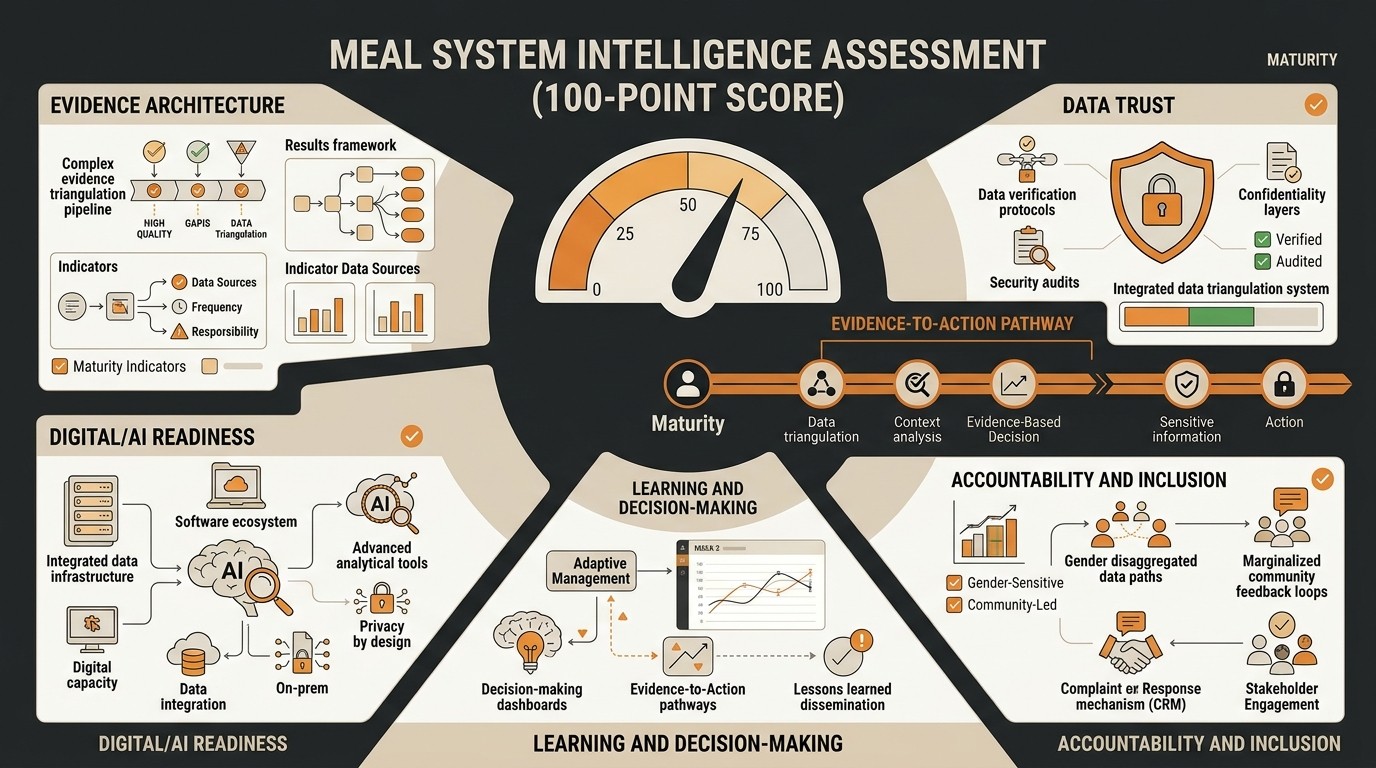
MEAL System Health Checklist: 40 Questions Every Development Organisation Should Ask
A MEAL system can contain all the expected components and still fail to produce useful evidence.
An organisation may have:
indicators;
data-collection tools;
dashboards;
feedback mechanisms;
quarterly reports;
evaluations;
and dedicated MEAL staff.
But the more important questions are:
Does the organisation know what it is trying to learn?
Can it trust the information it collects?
Do programme teams understand what the evidence means?
Can communities influence the programme?
Does evidence actually affect decisions?
That is what this checklist is designed to explore.
The Mizan Evidence MEAL System Health Checklist provides 40 diagnostic questions across eight dimensions of a functioning Monitoring, Evaluation, Accountability and Learning system.
It is designed for NGOs, civil-society organisations, development programmes, humanitarian actors, implementing partners and other organisations that want to understand where their MEAL system is strong and where it may require strengthening.
The purpose is not to achieve a perfect score. The purpose is to identify where weaknesses in the evidence system could affect programme quality, accountability or decision-making.
What Does a Healthy MEAL System Look Like?
A healthy MEAL system connects several functions that are often treated separately.
It begins with a clear understanding of the change a programme is trying to contribute to.
It then translates that logic into meaningful indicators, evaluation questions and learning priorities.
It collects information through appropriate and ethical methods.
It protects data quality.
It listens to communities.
It analyses evidence rather than merely aggregating it.
It creates space for reflection.
And ultimately, it helps people make decisions.
A simplified pathway looks like this:
Programme logic
↓
Indicators and learning questions
↓
Data collection
↓
Data quality and protection
↓
Analysis
↓
Community and stakeholder perspectives
↓
Reflection and learning
↓
Decision
↓
Adaptation
A weakness anywhere in this chain can reduce the usefulness of the entire system.
For example, excellent data collection cannot compensate for indicators that measure the wrong thing.
A sophisticated dashboard cannot compensate for unreliable data.
A strong evaluation cannot create organisational learning if nobody acts on the findings.
And a technically sound monitoring system cannot create accountability if communities have no meaningful way to influence the programme.
That is why MEAL should be assessed as a system, not simply as a collection of tools.
How to Use This Checklist
Score each statement using the following scale:
0 = Not in place
The organisation does not currently meet the condition, or there is no reliable evidence that it does.
1 = Partly in place
Some elements exist, but implementation is inconsistent, incomplete or dependent on particular individuals or projects.
2 = Consistently in place
The practice is clearly established, documented where appropriate and routinely applied.
There are 40 questions.
The maximum possible score is:
80 points
But the total score should never be interpreted by itself.
A serious weakness in safeguarding, data protection, accountability or evidence quality may require immediate attention even if the overall score is relatively high.
This is a practical self-assessment framework, not a certification standard or statistically validated diagnostic scale.
Its value lies primarily in the discussion and action it generates.
Dimension 1: Programme Logic and Evidence Needs
A MEAL system should begin with clarity about what the programme is trying to achieve.
If programme logic is weak, measurement usually becomes weak as well.
1. Are programme outputs, outcomes and longer-term results clearly distinguished?
Score: 0 / 1 / 2
A programme should be able to distinguish what it delivers from the changes expected to result from those outputs.
For example:
Training delivered is not the same as knowledge improved.
Knowledge improved is not the same as professional behaviour changed.
Professional behaviour changed is not automatically the same as services improved.
If those levels are blurred, indicators may measure activities while reports make claims about outcomes.
2. Is there a credible explanation of how programme activities are expected to contribute to outcomes?
Score: 0 / 1 / 2
The organisation should be able to explain the causal pathway connecting intervention and intended change.
Ask:
Why should this activity produce this outcome?
If the explanation depends mainly on assumptions such as:
Training people will improve performance.
then the Theory of Change may require deeper examination.
3. Are the programme's most important assumptions explicitly identified?
Score: 0 / 1 / 2
Every programme depends on assumptions.
For example:
participants will attend;
staff will apply new skills;
partner institutions will cooperate;
markets will remain accessible;
services will remain available;
communities will trust the intervention.
Important assumptions should be visible so they can be monitored or investigated.
4. Are important external factors and contextual risks considered?
Score: 0 / 1 / 2
Programmes do not operate in isolation.
Results may be influenced by:
political change;
conflict;
economic conditions;
migration;
climate events;
policy reforms;
institutional turnover;
market conditions;
social norms.
A healthy MEAL system distinguishes programme performance from important contextual influences.
5. Are monitoring, evaluation and learning questions connected to real management needs?
Score: 0 / 1 / 2
The programme should be able to explain what it genuinely needs to know.
For example:
Why is participant retention lower among women?
Which delivery model produces better outcomes?
What prevents trained staff from applying the new procedure?
These questions are often more useful than collecting additional indicators without a clear purpose.
Dimension 1 warning sign
Your programme team can describe its activities in detail but struggles to explain the pathway from activities to meaningful change.
Dimension 2: Indicators, Baselines and Targets
Indicators should provide useful signals about programme performance and results.
They should not exist simply because a logframe requires empty cells to be filled.
6. Does every priority result have appropriate indicators?
Score: 0 / 1 / 2
Important outcomes need evidence.
If a programme claims to strengthen institutional capacity but measures only the number of staff trained, an important measurement gap exists.
7. Are indicator definitions precise enough for different staff to calculate them consistently?
Score: 0 / 1 / 2
An indicator should define important concepts.
For percentage indicators, numerator and denominator should also be clear.
For example:
Percentage of participants applying improved practices
requires clarification of:
who counts as a participant;
what counts as applying;
which practices qualify;
when measurement occurs;
and how application is verified.
8. Does the framework contain an appropriate balance of output and outcome indicators?
Score: 0 / 1 / 2
Outputs tell us what was delivered.
Outcomes tell us what changed.
Both matter.
A framework dominated entirely by activity and output measures may tell an organisation a great deal about implementation while revealing little about results.
9. Are baselines available or appropriately planned where needed?
Score: 0 / 1 / 2
A result such as:
68 percent of participants demonstrate the targeted competency
is difficult to interpret without knowing the starting condition.
A baseline provides the reference point required to understand change where such comparison is relevant.
10. Are targets justified and useful rather than arbitrary?
Score: 0 / 1 / 2
Targets should reflect:
baseline conditions;
available resources;
implementation duration;
historical performance;
programme ambition;
contextual constraints;
and plausible expectations.
A target chosen only because it "looks ambitious" is less useful for performance management.
Dimension 2 warning sign
Your indicators are easy to report, but programme managers cannot explain what many of them tell you about actual results.
Dimension 3: Data Collection and Management
Even good indicators become unreliable when data collection and management systems are weak.
11. Are data-collection methods appropriate to the question being answered?
Score: 0 / 1 / 2
The method should fit the evidence need.
A satisfaction survey cannot answer every question about service quality.
A focus group cannot automatically provide representative prevalence estimates.
Administrative data may be useful but may not capture participant experience.
Choose the method because it fits the question, not simply because it is convenient.
12. Are data-collection tools standardised where consistency is required?
Score: 0 / 1 / 2
Different offices should not collect supposedly comparable indicators using substantially different questions or definitions unless there is a clear methodological reason.
Standardisation helps preserve comparability.
13. Do staff and enumerators receive adequate instructions and training?
Score: 0 / 1 / 2
A technically excellent questionnaire can still produce poor data if enumerators:
interpret questions differently;
skip probing instructions;
fail to understand consent;
enter values inconsistently;
or do not know how to respond to sensitive disclosures.
Training and supervision are part of data quality.
14. Is there a clear system for storing, versioning and retrieving evidence?
Score: 0 / 1 / 2
Ask:
Where is the final dataset?
Which spreadsheet is authoritative?
Can previous reporting values be reproduced?
Can supporting documentation be located?
Who controls access?
If several people provide different answers, data management may require strengthening.
15. Does the organisation avoid unnecessary or duplicative data collection?
Score: 0 / 1 / 2
Collecting more data is not automatically better.
Repeated surveys may create:
respondent fatigue;
unnecessary cost;
duplicated databases;
privacy risks;
staff workload.
Before collecting new information, ask whether the evidence already exists.
Dimension 3 warning sign
Different teams maintain separate datasets, and nobody is completely certain which version contains the final approved numbers.
Dimension 4: Data Quality
The question is not whether your dataset looks clean.
The question is whether decision-makers understand how much confidence they should place in it.
16. Are routine checks performed for missing, duplicate, inconsistent or implausible data?
Score: 0 / 1 / 2
Examples include:
missing values;
duplicate records;
invalid dates;
impossible ages;
contradictory responses;
unexpected denominator changes;
unusual patterns.
Many of these checks can be automated.
Important anomalies should still be investigated by people.
17. Can reported results be traced back to their original source?
Score: 0 / 1 / 2
If a report states:
1,247 participants received services
someone should be able to explain where that number came from.
Traceability matters.
Important results should not depend on unexplained spreadsheet values copied from one reporting period to another.
18. Are important indicator calculations reproducible?
Score: 0 / 1 / 2
A trained staff member should be able to take the same approved data and indicator definition and reproduce the reported result.
If not, the calculation process may be insufficiently documented.
19. Are known data-quality limitations communicated to decision-makers?
Score: 0 / 1 / 2
Data limitations should not disappear simply because a report needs a clear conclusion.
For example:
low response rates;
high attrition;
missing geographic coverage;
possible response bias;
weak administrative records.
Transparent limitations improve decision-making.
They do not automatically make the evidence useless.
20. Are higher-risk indicators subject to stronger verification?
Score: 0 / 1 / 2
Not every indicator requires the same level of verification.
An indicator linked to:
payments;
beneficiary eligibility;
major donor commitments;
protection;
programme success claims;
or strategic decisions
may justify stronger quality controls than a low-risk operational indicator.
Data-quality systems should be proportionate to risk.
Dimension 4 warning sign
Staff trust the dashboard because it looks professional, but nobody can explain how several important values were verified.
Dimension 5: Accountability and Community Feedback
Communities should not be treated only as sources of data.
Accountability requires meaningful opportunities to receive information, provide feedback, raise concerns and influence programming.
21. Can community members safely provide feedback and complaints through accessible channels?
Score: 0 / 1 / 2
One mechanism is rarely accessible to everyone.
Consider:
language;
literacy;
disability;
digital access;
gender;
age;
confidentiality;
distance;
social power.
Different populations may require different channels.
22. Are feedback mechanisms accessible to groups at risk of exclusion?
Score: 0 / 1 / 2
Low use of a feedback mechanism does not necessarily mean people are satisfied.
It may mean the mechanism is inaccessible.
Ask who is not using the mechanism and why.
23. Is feedback analysed for patterns rather than managed only case by case?
Score: 0 / 1 / 2
Closing individual complaints is important.
But aggregate analysis can identify structural problems.
For example:
repeated complaints about waiting times;
recurring questions about eligibility;
feedback concentrated in one location;
patterns involving particular services.
Individual cases can reveal system-level issues.
24. Do programme teams receive and discuss relevant feedback trends?
Score: 0 / 1 / 2
Feedback has limited programme value if it remains inside an accountability database.
Programme managers should understand what communities are repeatedly saying about implementation.
25. Can the organisation identify examples where community feedback influenced programming?
Score: 0 / 1 / 2
This is the strongest test.
What changed?
Perhaps:
service hours changed;
communication improved;
a distribution process was redesigned;
a referral pathway was corrected;
staff behaviour was addressed;
a programme activity was modified.
If no examples can be identified, ask whether the feedback loop is genuinely complete.
Dimension 5 warning sign
Your organisation can report how many complaints it received but cannot explain what it learned from them.
Dimension 6: Analysis and Evidence Use
Collecting data is only the beginning.
Evidence becomes useful when people analyse it, question it and connect it to decisions.
26. Are monitoring data analysed rather than merely aggregated?
Score: 0 / 1 / 2
Reporting totals is not the same as analysis.
Analysis asks:
What changed?
Where?
For whom?
Compared with what?
Why might this be happening?
What evidence contradicts the apparent pattern?
27. Are important results examined across relevant groups and locations?
Score: 0 / 1 / 2
An overall average can hide important differences.
Compare results where relevant by:
location;
sex;
age;
disability;
delivery model;
partner;
cohort;
other meaningful characteristics.
Disaggregate because differences matter, not simply because a reporting template requests it.
28. Do programme and MEAL teams review evidence together?
Score: 0 / 1 / 2
Evidence should not remain inside the MEAL department.
Programme teams contribute:
context;
implementation knowledge;
technical understanding;
operational explanation.
MEAL teams contribute:
measurement discipline;
data-quality awareness;
analytical challenge;
methodological interpretation.
The strongest understanding often comes from combining these perspectives.
29. Are significant deviations investigated rather than simply explained in reports?
Score: 0 / 1 / 2
Suppose performance falls below target.
A report might say:
The target was not achieved due to implementation delays.
But how do we know?
What evidence supports that explanation?
Could targeting, data quality, participation barriers or contextual changes also matter?
An explanation should be investigated, not simply written.
30. Can the organisation identify recent decisions influenced by MEAL evidence?
Score: 0 / 1 / 2
Ask programme managers:
What did you change because of evidence during the last six months?
Examples might include:
adjusting targeting;
changing delivery timing;
modifying training content;
strengthening supervision;
changing a partner process;
investigating an emerging risk.
If evidence never influences decisions, the problem may not be measurement.
It may be evidence use.
Dimension 6 warning sign
Your organisation produces extensive monitoring reports but cannot identify three recent decisions that changed because of them.
Dimension 7: Evaluation and Learning
Evaluation should help organisations answer important questions that routine monitoring cannot answer adequately.
Learning should then connect findings with future action.
31. Are evaluations commissioned around genuine evidence needs?
Score: 0 / 1 / 2
Some evaluations are contractually required.
Even then, the organisation should ask:
What do we genuinely need to learn?
Which decisions are approaching?
Which assumptions need testing?
What remains uncertain?
A compliance requirement can still become a useful evaluation.
32. Are evaluation questions focused and decision-relevant?
Score: 0 / 1 / 2
An evaluation should not attempt to answer every possible question.
Prioritise what matters most to:
programme improvement;
future design;
strategic decisions;
accountability;
learning.
33. Are evaluation recommendations prioritised and followed up?
Score: 0 / 1 / 2
A recommendation should ideally have:
a management response;
priority;
responsible owner;
deadline;
follow-up status.
Otherwise, evaluation recommendations can disappear after the final presentation.
34. Are lessons from previous programmes accessible during new programme design?
Score: 0 / 1 / 2
Organisations often repeat problems they have already studied.
Ask:
Can teams find previous evaluations?
Can they locate relevant recommendations?
Are lessons used when new proposals and programme designs are developed?
Institutional memory is part of learning.
35. Are there structured opportunities for reflection and adaptation?
Score: 0 / 1 / 2
Examples include:
quarterly learning reviews;
after-action reviews;
pause-and-reflect sessions;
implementation retrospectives;
cross-project learning meetings.
The format matters less than the outcome.
The question is:
Did reflection lead to action?
Dimension 7 warning sign
Evaluations are completed, approved, uploaded and rarely opened again.
Dimension 8: People, Governance, Data Protection and Responsible Technology
A MEAL system depends on people, responsibilities and organisational governance.
Technology can support the system, but it does not replace these fundamentals.
36. Are MEAL roles and responsibilities clear across teams?
Score: 0 / 1 / 2
Programme managers, field staff, MEAL specialists, technical advisers and leadership should understand their responsibilities.
MEAL should not become something that only the MEAL officer understands.
37. Do programme staff understand the evidence they help generate?
Score: 0 / 1 / 2
Staff responsible for implementation should understand:
what important indicators mean;
why information is collected;
how data are used;
what findings currently show.
This supports data quality and evidence ownership.
38. Are appropriate safeguards in place for personal, confidential and sensitive MEAL data?
Score: 0 / 1 / 2
Consider:
access controls;
data minimisation;
secure storage;
retention;
sharing;
consent;
de-identification;
incident response;
staff awareness.
Not all MEAL information carries the same sensitivity.
Controls should reflect risk.
39. Where AI or automated tools are used, are privacy, verification, human oversight and accountability addressed?
Score: 0 / 1 / 2
Using AI to summarise documents or analyse monitoring information does not remove organisational responsibility.
Ask:
Which tools are approved?
What data may be uploaded?
What data are prohibited?
How are outputs verified?
Who remains responsible?
Is material AI use documented?
AI should strengthen evidence work without weakening confidentiality or human judgment.
40. Does the organisation have sufficient resources and capacity to operate the MEAL system realistically?
Score: 0 / 1 / 2
A system that looks excellent on paper may fail if it requires:
more staff than exist;
more surveys than the budget can support;
technical skills the organisation does not have;
reporting frequency teams cannot maintain.
MEAL systems should be fit for purpose and proportionate.
Dimension 8 warning sign
Your MEAL plan expects sophisticated evidence production, but the staff time, skills, budget or governance needed to operate it do not exist.
Calculate Your Score
Add your scores across all 40 questions.
Maximum:
80 points
Use the following ranges as an initial conversation starter.
65 to 80: Strong Foundation
Most major MEAL components appear to be functioning.
Focus on:
remaining weak dimensions;
system efficiency;
advanced analysis;
learning;
evidence use;
continuous improvement.
Do not assume a high score means there are no serious risks.
Review any individual zero scores carefully.
49 to 64: Functional but Uneven
The organisation has many MEAL foundations in place, but weaknesses are likely reducing consistency or usefulness.
Focus on identifying which dimensions are weakest.
Avoid trying to strengthen everything simultaneously.
33 to 48: Significant Strengthening Needed
Several weaknesses may be affecting:
evidence credibility;
accountability;
programme understanding;
decision-making.
Prioritise fundamentals before introducing more sophisticated tools or technology.
0 to 32: Major System Gaps
The organisation may need more substantial strengthening.
Begin with:
programme logic;
priority indicators;
data responsibilities;
basic data quality;
accountability;
evidence-review processes.
Do not try to build an elaborate system immediately.
Create a reliable foundation first.
Your Total Score Is Not the Most Important Result
Two organisations can both score 58 and face completely different risks.
Organisation A may have excellent data quality but weak organisational learning.
Organisation B may have strong learning processes but unreliable indicators.
The total score hides those differences.
Calculate a score for each dimension as well.
Each dimension contains five questions and therefore has a maximum score of:
10 points
This gives you a simple diagnostic profile.
For example:
Programme Logic: 8/10
Indicators: 5/10
Data Collection: 7/10
Data Quality: 4/10
Accountability: 8/10
Evidence Use: 3/10
Evaluation & Learning: 6/10
Governance & Capacity: 7/10
This profile is considerably more useful than the total alone.
It immediately shows where strengthening should begin.
Pay Special Attention to Zero Scores
Not every question carries identical organisational risk.
A zero in some areas may require urgent attention regardless of the overall score.
Examples include:
no safe complaint mechanism;
serious weaknesses protecting sensitive information;
important results that cannot be verified;
unclear safeguarding-related responsibilities;
systematic inconsistencies in critical indicators.
This is why the checklist should support professional judgment rather than replace it.
Do not allow a good total score to hide a serious individual risk.
Five Questions to Ask After Scoring
The assessment becomes useful only when it leads to discussion.
Ask these five questions.
1. Where are our weakest dimensions?
Look beyond individual questions.
Are weaknesses concentrated in:
programme design;
data;
accountability;
learning;
evidence use;
capacity?
Patterns matter.
2. Which weakness creates the greatest risk?
The lowest numerical score is not automatically the highest priority.
For example, weak graphic design of dashboards may be less urgent than unreliable beneficiary data.
Prioritise according to consequence.
3. Which weakness most affects evidence credibility?
Ask whether important decisions could currently be based on information that is:
poorly defined;
incomplete;
inconsistent;
biased;
unverified.
Those weaknesses deserve attention.
4. Which weakness prevents evidence from influencing decisions?
Sometimes data collection is reasonably strong.
The missing connection is between evidence and management.
Look for:
reports nobody discusses;
dashboards nobody uses;
evaluations without follow-up;
feedback systems disconnected from programme teams.
5. Which improvements can we realistically make now?
Separate:
quick wins
from
structural improvements.
A quick win might be:
defining an indicator;
introducing a monthly feedback review;
fixing a calculation;
clarifying ownership;
removing a duplicate form.
Structural improvement may require:
redesigning the Theory of Change;
building a data-management system;
conducting a baseline;
revising accountability architecture;
building staff capacity.
Both matter.
They require different timelines.
Build a MEAL Strengthening Plan
Do not end the exercise with a score.
Convert the findings into action.
For every priority weakness, document:
Finding
What is wrong?
Risk
Why does it matter?
Priority
High, medium or low.
Action
What exactly will be changed?
Owner
Who is responsible?
Deadline
When will it happen?
Evidence of completion
How will you know the action was completed?
Follow-up
When will progress be reviewed?
Example
Finding
Outcome indicators have inconsistent definitions across programmes.
Risk
Results may not be comparable or reproducible.
Priority
High.
Action
Develop and approve Indicator Reference Sheets for the 12 priority outcome indicators.
Owner
MEAL Lead with Programme Managers.
Deadline
Within 30 days.
Evidence of completion
Approved reference sheets and updated reporting instructions.
Follow-up
Verify implementation during the next reporting cycle.
That is where assessment becomes strengthening.
A Practical 30-Day MEAL Health Improvement Plan
If the checklist reveals several weaknesses, do not redesign the entire system immediately.
Use the first 30 days to establish priorities.
Week 1: Understand the Current System
Map:
programme logic;
indicators;
data sources;
tools;
databases;
feedback mechanisms;
reports;
evaluations;
learning processes;
decision points;
staff responsibilities.
Do not begin by changing everything.
Understand the system first.
Week 2: Diagnose the Highest-Risk Gaps
Select approximately five issues with the greatest implications for:
programme quality;
evidence credibility;
accountability;
decision-making;
organisational risk.
Avoid choosing only the easiest problems.
Week 3: Define Corrective Actions
For each priority, establish:
specific action;
responsibility;
timeline;
resource requirement;
completion evidence.
Avoid statements such as:
Improve data quality.
Use:
Introduce monthly automated duplicate, missingness and consistency checks for the beneficiary monitoring dataset, with identified anomalies reviewed by the MEAL Officer before quarterly reporting.
Specific actions are easier to implement.
Week 4: Implement Quick Wins and Build the Longer Roadmap
Fix several practical problems immediately.
Then build a realistic roadmap for structural issues.
The result should be a prioritised strengthening plan rather than a long list of everything that could theoretically be improved.
Do Not Automatically Respond by Adding More MEAL
A weak MEAL system does not necessarily need:
more indicators;
more surveys;
more dashboards;
more reports;
more software;
more forms;
more meetings.
Sometimes strengthening means removing things.
Remove an indicator nobody uses.
Simplify a data-collection form.
Consolidate duplicate databases.
Reduce unnecessary reporting.
Clarify one important result.
Define one ambiguous indicator.
Create one meaningful evidence-review process.
The objective is not to create the largest possible system.
It is to create the smallest system capable of producing credible evidence for the decisions the organisation genuinely needs to make.
The Five Questions Senior Leadership Should Ask
MEAL system health is not only a technical issue.
Leadership plays a critical role.
Senior management should periodically ask:
1. Are we collecting evidence we genuinely need?
Or are we collecting information because the system has always collected it?
2. Do we trust our most important results?
Which numbers carry the greatest uncertainty?
What are the major limitations?
3. Are we willing to hear evidence that contradicts our expectations?
An organisation does not have a strong evidence culture if staff are encouraged to report success but discouraged from reporting problems.
4. Can communities meaningfully influence our programmes?
Accountability is not simply collecting feedback.
It requires responsiveness.
5. Can we identify decisions that changed because of evidence?
If not, the main MEAL problem may not be data collection.
It may be evidence use.
Frequently Asked Questions
What Is a MEAL System Health Check?
A MEAL System Health Check is a structured review of the processes, tools, responsibilities and practices used to generate and use monitoring, evaluation, accountability and learning evidence.
It should examine the system as a whole rather than focusing only on individual tools.
Is This Checklist a Formal Certification?
No.
This checklist is a practical Mizan Evidence diagnostic framework designed to support organisational reflection and prioritisation.
It is not a certification standard and the scoring thresholds should not be treated as scientifically validated organisational ratings.
Professional judgment and context remain essential.
Who Should Complete the Checklist?
Ideally, it should not be completed by one person alone.
Useful participants may include:
MEAL staff;
programme managers;
technical advisers;
field staff;
data staff;
accountability staff;
senior management.
Different perspectives may reveal different weaknesses.
One particularly useful exercise is to ask several teams to score the system independently and then compare their answers.
Large differences in scores can themselves reveal important organisational issues.
How Often Should We Assess Our MEAL System?
There is no universal required frequency.
A review may be especially valuable:
when a new programme begins;
when an organisation grows significantly;
after major programme redesign;
when data-quality problems emerge;
after an evaluation identifies systemic weaknesses;
when donor requirements change;
or when staff consistently struggle to use existing evidence.
A periodic organisational review can also help identify inefficiencies that accumulated over time.
Does a High Score Mean Our MEAL System Is Excellent?
Not necessarily.
The score is a diagnostic prompt.
A high total can coexist with a serious weakness in one critical area.
Always examine individual questions and dimension scores.
Does a Low Score Mean We Need a Completely New MEAL System?
No.
Many organisations can make substantial improvements by strengthening a relatively small number of critical processes.
Examples include:
clarifying indicators;
improving data-quality controls;
strengthening feedback analysis;
clarifying responsibilities;
simplifying data flows;
introducing structured evidence reviews.
Redesign only what genuinely needs redesigning.
Should We Buy New MEAL Software?
Not automatically.
Software may help with efficiency, data management and analysis.
It does not fix:
weak programme logic;
poor indicator design;
unclear responsibilities;
weak data quality;
limited accountability;
poor evidence use.
Define the problem first.
Then determine whether technology is part of the solution.
Can AI Improve a MEAL System?
Yes, in specific areas.
AI can potentially support:
indicator review;
data-quality checks;
qualitative coding;
evidence retrieval;
report drafting;
learning synthesis.
But AI should not substitute for:
human judgment;
contextual understanding;
data protection;
methodological rigour;
community engagement;
accountability.
A weak MEAL system can produce poor evidence faster with AI.
Strengthen the fundamentals first.
Final Takeaway
A healthy MEAL system is not defined by how many dashboards, indicators or reports an organisation produces.
It is defined by whether the organisation can move reliably from:
programme logic
to
credible evidence
to
understanding
to
decision
to
adaptation
to
learning.
A healthy system helps an organisation answer:
What are we trying to achieve?
What evidence will tell us whether progress is occurring?
Can we trust that evidence?
Whose experience are we missing?
What are communities telling us?
What remains uncertain?
What should we do next?
That is the real purpose of MEAL.
A strong MEAL system does not simply document a programme. It helps the organisation understand and improve it.
Mizan Evidence Perspective
There is no universal MEAL system that every organisation should copy.
A small civil-society organisation does not need the same architecture as a multi-country donor programme.
A humanitarian response operates differently from a long-term governance intervention.
An evaluation-focused organisation has different evidence requirements from a direct service provider.
The right MEAL system should therefore be fit for purpose.
It should be:
clear enough to understand;
rigorous enough to trust;
practical enough to operate;
safe enough to protect people and data;
responsive enough to hear communities;
and
useful enough to influence decisions.
The goal is not more MEAL.
The goal is better evidence and better use of evidence.
How Healthy Is Your MEAL System?
The 40 questions above provide an initial diagnostic.
The next step is not simply calculating your score.
It is deciding what should improve.
Assess your MEAL system to identify strengths, risks and practical priorities for strengthening.
ASSESS YOUR MEAL SYSTEM
Sources & Further Reading
Core Humanitarian Standard Alliance, Groupe URD and Sphere
Core Humanitarian Standard on Quality and Accountability, 2024 Edition
Guidance on quality, accountability, participation, feedback, learning and organisational responsibility.
International Fund for Agricultural Development (IFAD)
Theory of Change and Logical Framework Guidance
Practical guidance on results chains, programme logic, indicators, baselines, targets and means of verification.
OECD Development Assistance Committee
Applying Evaluation Criteria Thoughtfully
Guidance on the appropriate use of relevance, coherence, effectiveness, efficiency, impact and sustainability within evaluation.
UNDP
Handbook on Planning, Monitoring and Evaluating for Development Results
Guidance on results-based planning, monitoring, evaluation, evidence use and organisational learning.
UNESCO
Recommendation on the Ethics of Artificial Intelligence
International guidance addressing human oversight, privacy, transparency, accountability and responsible use of artificial intelligence.
International Committee of the Red Cross (ICRC)
Handbook on Data Protection in Humanitarian Action
Guidance on protecting personal and sensitive information within humanitarian and development-related data processes.